Your dog pulls for a reason. Every fix you have tried was made for some other dog.
PupSteady builds a 30-day loose-leash plan for your dog. It checks in with you every day and changes the plan off what you tell it.
Runs in your phone's browser. A two-minute check-in each day.
You know the moment.
You open the front door. Your dog is out before you are.
The leash goes tight before your second foot leaves the step. Your arm goes straight. Your shoulder takes the hit.
Then it's the whole street like that. Your dog at the end of the leash, nose down, going. You at the other end, leaning back, half walking and half being towed.
A neighbor with a calm little spaniel slows down to watch. You say "no" in the low voice. It doesn't even register.
You get home with a sore shoulder and a red line across your palm.
And tomorrow there are two more walks.
Some mornings you go out at six so fewer people see. Some days the long walk turns into one lap of the block. Some days the walk doesn't happen at all, and you feel bad about that too.
14That's fourteen walks a week.
One more week of waiting is fourteen more like this.
You have already tried the sensible things
You haven’t been lazy about this. You’ve tried.
Treats.
The treat gets eaten. Then the pulling starts again.
“No.”
It works in the kitchen. It doesn’t work when there’s a cat under a car.
A shorter leash.
The pull is as hard as before. Now you’re just closer to it.
A harness.
The pull moved. It still ends up in your arm.
A YouTube video or two.
The trainer made it look easy. Then your dog did something the dog in the video never did. And the video couldn’t tell you what to do next.
Each of those is fair advice. That’s the trouble.
It’s advice for dogs in general. You walk one particular dog.
Why none of it stuck
Pulling on the leash is four problems that look like one.
Some dogs pull from the second the door opens.
Some walk fine for ten minutes, then start.
Some only pull at other dogs.
Some pull at everything. Bikes, birds, trash cans, smells.
Each of those starts at a different moment on the walk. So each one needs a different first week.
A treat, a harness or a video can’t know which one your dog is. So it guesses. When the guess is wrong, it feels like your fault.
It isn’t.
Your dog on day ten is a different dog from day one.
Some things get better. Some get worse for a while. Something new shows up, like the mail carrier or the garbage truck.
A plan written once can’t keep up with that.
It’s also why a good trainer can help and still fall short. A trainer sees your dog for an hour. Your dog walks fourteen times a week.
You can’t tell if anything is working.
Three good days, then TuesdayOne bad Tuesday wipes out three good days in your head. So you drop things that may have been helping.
So the fix has three jobs.
It has to fit your dog.
It has to change as your dog changes.
And it has to show you what’s happening, walk by walk.
The treat was never the problem. The timing was, and the plan sets the timing for your dog.
Where the plan comes from
Every PupSteady plan is built on reward-based loose-leash training. You reward the walking you want, and a tight leash stops the walk. No leash jerks, no prong or shock collars.
That’s the approach veterinary behavior experts recommend.
Based on current scientific evidence, AVSAB recommends that only reward-based training methods are used for all dog training, including the treatment of behavior problems.
The guidelines strongly endorse positive behavior-modification techniques, such as rewarding correct behaviors and removing rewards for unwanted behaviors.
Quoted from each organization’s website. Neither organization has reviewed or endorsed PupSteady.
That is what PupSteady does
PupSteady is an app that runs in your phone’s browser. Nothing to download. It writes a 30-day loose-leash plan for your dog. It checks in with you every day. Then it changes the plan from your answers.
Here is how it works.
You tell it about your dog
A short set of questions. Breed. Age. What you’ve already tried.
Then the pulling itself. Does it start at the door? After ten minutes? At other dogs? At everything?

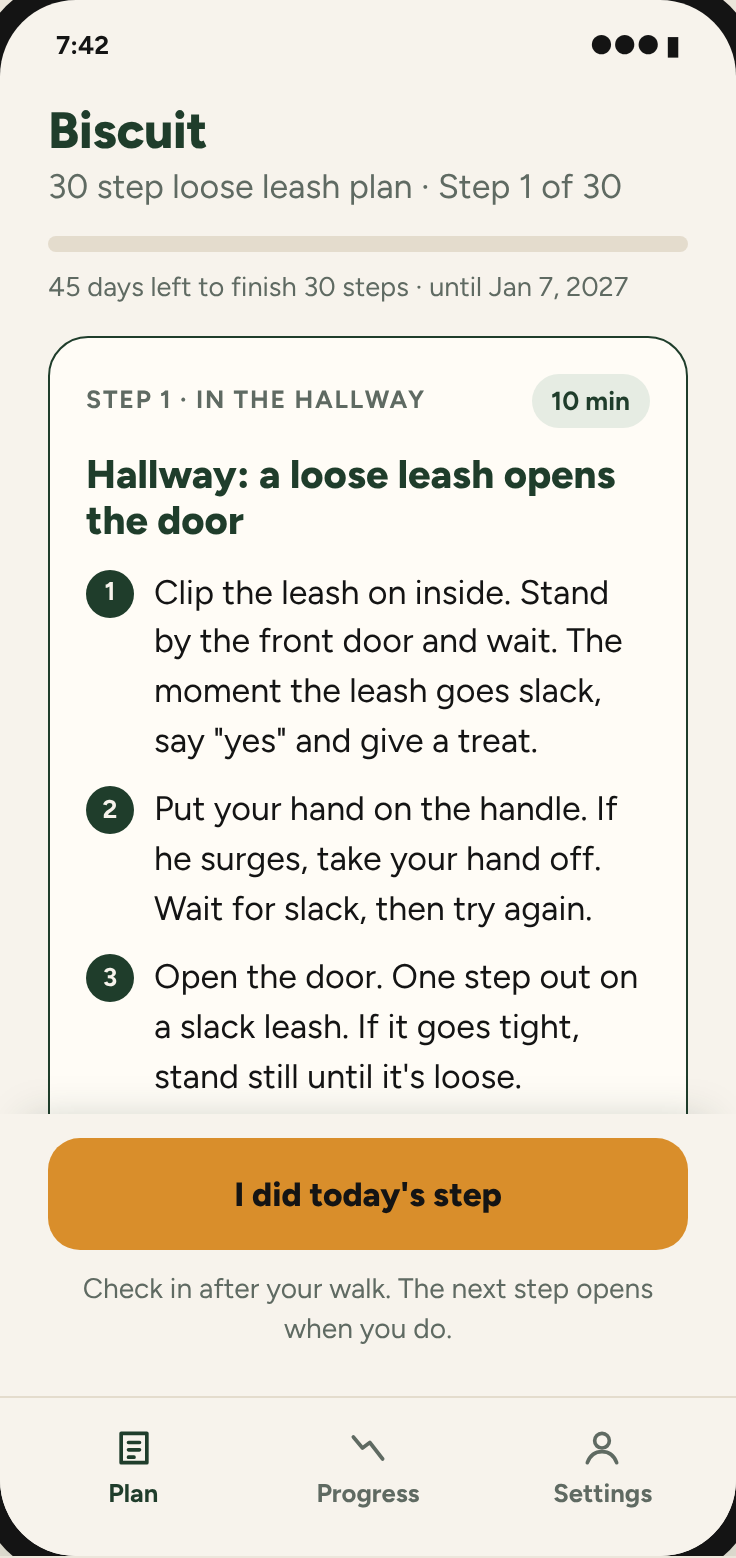
It writes your dog’s plan
A 30-day plan built from those answers. For your dog, from day one.
It lives in the app. So it’s in your pocket on the walk.
You walk, then you check in
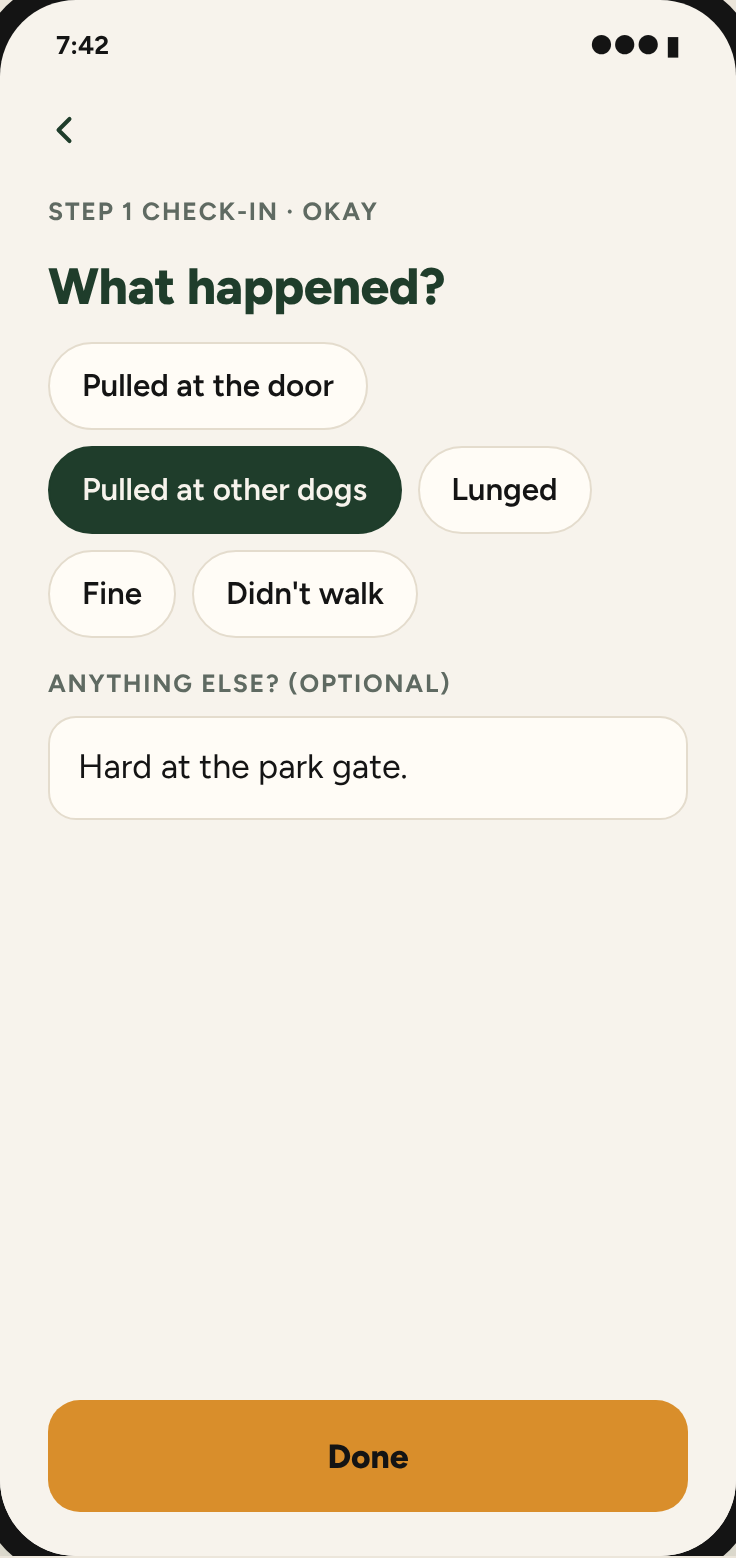
Once a day the app sends you a check-in. It asks how the walks went. It takes about two minutes.
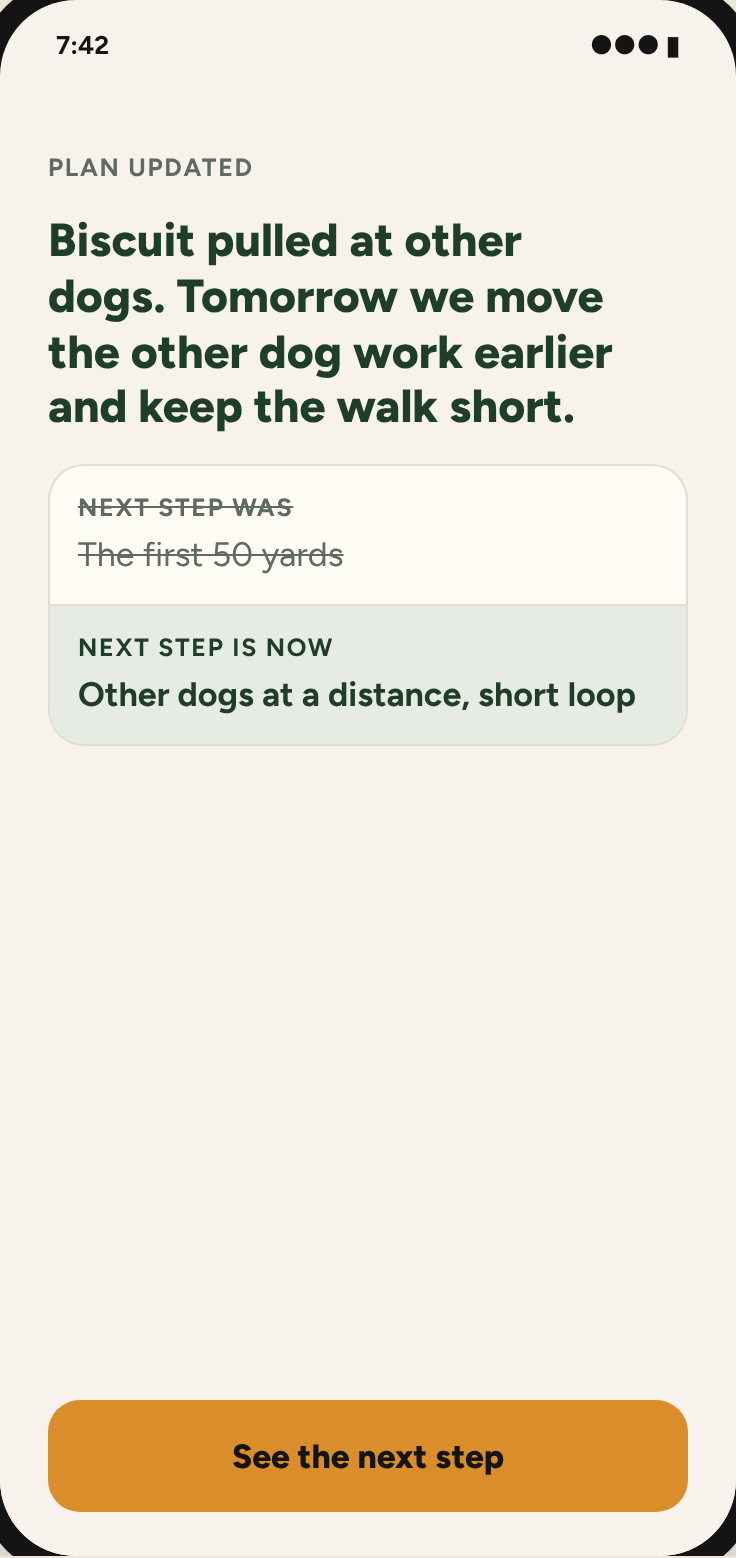
The plan changes off your answers
A good few days and the plan moves on. A rough patch at the park gate and the plan changes to work on that.
It remembers your dog. Breed, age, what you tried, every check-in since day one.
You never start from zero.
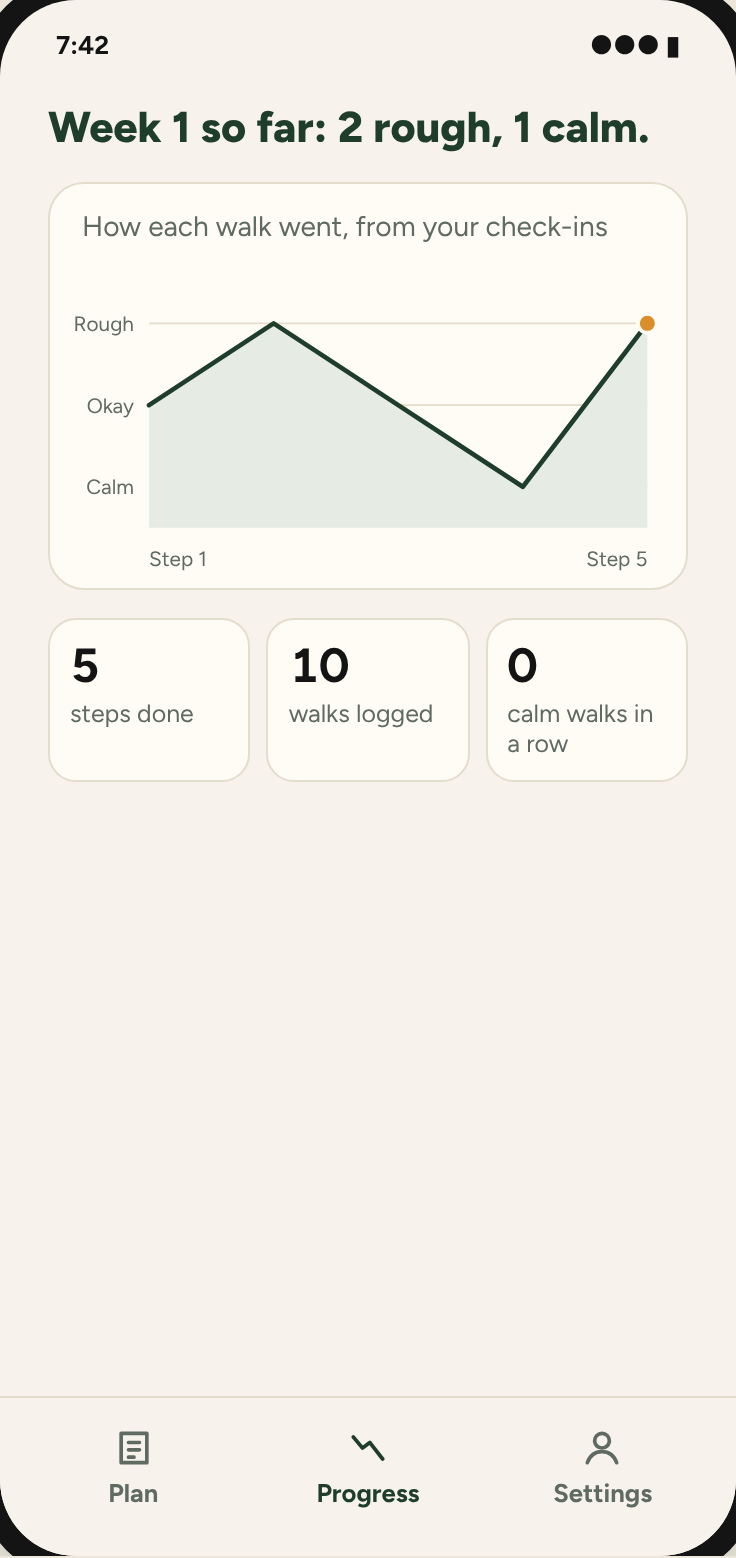
You see the walks on a tracker
Every check-in goes on the tracker.
So on a bad day you can scroll back. You’ll see where you started. You’ll see how the last two weeks went.
“Couldn’t I ask a chat box the same thing?”
You could ask. You’d get an answer. Then you’d close it.
Tomorrow you’d start again. Type the breed again. Explain the door again. Explain what you tried again.
It doesn’t check in. It doesn’t notice Thursday went worse than Monday. It keeps no record of the walks.
PupSteady holds all of that for you. Day 14 of the plan is built on everything from days 1 to 13.
A printed 30-day plan has the same problem. It says the same thing on day 20 that it said on day 1.
Your dog won’t stay the same for 20 days.
What the 30 days are for
You know, when you open the door and the leash stays loose down the path, you’ll have a walk you can start without bracing first. Which will allow you to take the long way around again. Past the park. In daylight. Past the neighbors.
We can’t promise how fast your dog will change. Every dog is different.
What you get is a plan that fits your dog, changes along the way, and shows you every walk as it happens.
What you get
- Your dog’s own 30-day loose-leash plan, built in the app from your answers
- A 2-minute check-in every day, so the plan changes as your dog does
- A plan that remembers your dog. Breed, age, what you tried, every walk you log
- A tracker of the walks, so you can see the trend for yourself
- All of it on your phone. Nothing to print. No calls. No appointments.
What it costs
Add up what you’ve spent so far.
One payment.$27
Try it for 30 days. If it isn’t for you, get your $27 back.
Start the plan. Take the walks. Answer the check-ins.
If at any point in the 30 days you decide it isn’t for you, ask for a refund. You get the full $27 back.
The 30 days count from the day you buy.
You can stop any day and go back to doing what you were doing.
The plan is 30 steps, one a day, and you get 45 days to finish them. So a missed day doesn’t cost you anything.
It costs you a two-minute check-in a day to try.
It opens in your phone’s browser. No download, no password. We email you the link.
Once you’re in, you answer the questions about your dog. The plan is built from your answers. Tonight’s walk can be the first one on the tracker.
Questions owners ask
My dog is older, or stubborn. Will it still work?
Every dog is different, so we won’t promise a result. The plan starts from your dog’s age, breed and what you’ve tried. Then it changes off how each walk goes. And the 30 days are covered.
How much time does it take?
The check-in takes about two minutes a day. The rest happens on the walks you already take.
Do I have to talk to anyone?
No. No calls. No video of you. It all happens in the app.
My dog lunges or snaps at other dogs.
PupSteady gives behavior guidance for pulling on the leash. It is not veterinary advice and it can’t assess aggression. If your dog shows aggression, pain or a sudden change in behavior, speak to your vet or a qualified behaviorist first.
P.S. One more week is fourteen more walks. Start the plan today and the next fourteen go on the tracker.